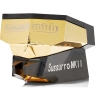
DO I have to ge the EXACT cartridge number I had??
No - You can upgrade (or downgrade) with the B&O designs - If you had an MMC5, 4, 3, 2, or 1, you CAN use any of our types SMMC4, 3, 2, 1, or The VOICE - you CANNOT use our SMMC20 series for these.
If you had an MMC3000, 4000, 5000 or 6000, OR any MMC10, OR any MMC20, you can use any of our SMMC20E, EN, CL or CL+ designs
Turntable and Cartridges FAQs - CLICK THESE:
Specs on Soundsmith Phono Cartridges ALL B&O cartridges are compatible with the standard Moving Magnet (or MM input) on your phone preamp - they are NOT "Moving Coil" and will not work correctly if used in a Moving Coil input with a MC preamp. The loading requirements are: 100pf, 47KOhms - Some ask: It is normal for me to have to turn the volume up more on my B&O cartridge that other inputs, like CD? > Yes - although the B&O cartidge is compatible with MM inputs, the output is a bit low, by design. Need a preamp for your MM or MC cartridge/turntable? We make them! Please click this> Soundsmith Phono Preamps
Select Model (new window will open)
|
| One channel out
troubleshooting
PLEASE NOTE: If you are trying to
cure a "ONE CHANNEL OUT" problem, you can try the following diagnostics to
verify if the problem is the cartridge, the turntable, or the phono preamp
section of your electronics.
First try to determine if it is the Electronics at fault. Play a record
and write down which channel is out. Now you must determine if the problem
is the turntable or the electronics. Turn the volume down, and inspect the
plug/s at the end of the wire coming from the turntable connecting it to
your stereo. If there are TWO PLUGS, they are called RCA plugs. If there
is only ONE round plug, it is a DIN connector, and you cannot do this
test. Make sure the volume is all the way down, and swap or reverse the RCA plug positions
at the back of your stereo where they are plugged into the PHONO input
jacks and start the record again. Turn the volume up a little bit. If the
same channel still out, the Electronics are likely at fault. If the
channel problem changes sides, it is either the cartridge, OR the turntable. You may
perform the following test, which is valid ONLY for the MMC1 through MMC5, which will rule out the turntable and prove that it IS the cartridge that is at fault. Original B&O cartridges sometimes do fail with age, and lose one channel.
Note which channel is NOW out, and write it down. Turn the volume all
the way down and unplug the cartridge, rotate it counterclockwise by 90 degrees and plug it back in so the stylus
is pointing sideways. Turn the volume up a very little bit. Be prepared to
gently hold the tone arm up off the record by loosely grasping the middle
of the tone arm, and press the play button on the turntable to make the
table act as if it is going to play a record. Note that on certain B&O
tables, you must have a record in place to do so. When it goes to play,
VERY gently and slightly rub the stylus BACK TO FRONT ONLY to see if the
sound is now coming out of the OTHER channel. If it is, the cartridge is
bad and must be replaced. Move the tone arm to the end of the record so
that it begins its own "end of record shut off" process.
|
|
HOW TO KNOW WHEN YOUR B&O CARTRIDGE MAY HAVE FAILED There are two major symptoms of MMC1-5 cartridge failure, and one for distortion on the MMC10 & MMC20 Series or SP series cartridges. For the MMC1 through MMC5
ONLY: 1) If there is a loss of one channel on your PHONO only. If that happens please go back to the top of the page and select “troubleshooting for a dead channel” If both channels are dead, you cannot use this technique to determine if it is the cartridge or the associated electronics at fault. You must use an OHMMETER, and check each pair of pins at the back end of the cartridge for conductance; opposing pins pairs should read between 700 and 800 ohms, and the pairs should be within 30 ohms of each other. CAUSES of Distortion for ALL MODELS: DEBRIS ON THE STYLUS TIP or IMPROPER TRACKING FORCE: One of the most common causes of distortion is a build up of debris on the stylus tip. The tip must be inspected, and if found to be fouled with debris, should be cleaned off with a stylus brush, and suitable solvent for such purpose. Careful inspection of the stylus tip will reveal severe accumulations of such debris.
Of course, you must verify that you are tracking at the correct force. Too light a tracking force will cause distortion especially during louder passages, and damage your records. Much too high a tracking force will do the same....Please refer to your turntable owners manual to learn how to adjust your particular tone arm. Most (BUT NOT ALL B&O TABLES) suggest verifying the "ZERO" balance of your tone arm, and then setting it for the proper tracking force. The MMC1-5 (or Soundsmith SMMC4,3, and 2) allow you to plug the cartridge in "incorrectly" with the stylus either pointing sideways or up, allowing you to set, or test, both zero balance and tracking force without much risk of damaging the stylus.... OTHER CAUSES – FAILED CARTRIDGE: If the tip is clear of debris, and the cartridge sounds very distorted or “grainy”, either the stylus has been broken off, or the suspension for the cantilever (the rod or arm that holds the stylus tip) has failed inside the cartridge body. To inspect the DIAMOND STYLUS tip in a very casual way, you need a bright light and a strong magnifier glass. The stylus tip (that plays the record) should protrude DOWN from the END of the small “rod” or “cantilever” which extends forward and slightly down from the bottom of the cartridge. That stylus tip should look like the tip of a pointed cone pointing DOWN from the END of the cantilever arm as you look sideways at the cartridge. If it looks flat, the diamond itself has broken off. If it looks like a downward pointing sharp cone, then it may be OK, and you must inspect the cantilever for its position as described below. The cantilever exits from a small hole in the METAL BODY of the cartridge. It has the black plastic shroud or stylus guard all around it. With a very bright light, and a very good magnifier, note the POSITION of the cantilever as it EXITS the hole in the METAL body of the cartridge. It SHOULD be 2/3 of the way down the hole, and CENTERED left to right. If it is off to one side, or touching the edge of the hole from which it exits, the suspension has failed, and the cartridge must be replaced. Be careful with the following procedure and note that you can damage the cartridge if it is not done very carefully. If all of the above appears OK, you may also VERY GENTLY deflect the stylus tip upwards. If the cantilever arm SUDDENLY seems to deflect up easily at a certain point in your deflecting it, that also is an indication that the internal suspension has failed. There should be continuous, gentle resistance to moving it upwards a very slight amount, as if it is resting on the record.
Please bear in mind that we can sometime rebuild the original B&O MMC1’s and MMC2’s only, AND only if they suffer from either channel failure, AND/OR suspensions failure. We cannot replace the cantilever or diamond on these models if it is broken off. At this time we DO rebuild the SP series of stylus shells for any failure.... |